Back in the Republic of Ireland
- bevclyde45
- Oct 11, 2025
- 6 min read

11-10-2025
Today was rainy, and by rainy, I mean sprinkles and mist. The weather didn't keep us from

our plans. Our first stop was Grianan of Aileach, (this is in English and I still don’t know what it says) a ring fort built about 900 AD. The walls are probably three feet thick, and I shudder to think of the labor that went into constructing this fort. I didn’t climb to the top due to the slippery steps, but the views on a clear day must be spectacular.
Our next stop was Donegal, a place I had been eagerly anticipating. In 1849, my great-grandfather, Charles Sproul, left Donegal for America. I don’t know much about him, but he likely emigrated due to the Potato Famine, known as the Great Hunger in Ireland. The timeline aligns. He was probably an Ulster Scot or Scot-Irish, perhaps one of those promised land in exchange for settling in Ireland. I think he was Protestant, as I don’t recall any Catholics in the family tree.
After arriving in the U.S., he settled in Pittsburgh, PA, got married, and raised a family. I have no idea if he stayed in touch with any Irish relatives, or if he even had any family left to contact. My own family hasn’t maintained ties with our Irish cousins, and I didn’t have time to search for them. Still, it was meaningful to visit the place where part of my family originated.

Donegal is a charming town, complete with its own castle. I think many Irish towns boast either a castle or at least the ruins of a monastery. I stopped for lunch in a quaint café and ordered a Coke, expecting the familiar red and white can. Instead, I received a silver can labeled "Palestine Cola" in pale orange. It struck me that many Irish people see parallels between their own history and the Palestinian cause, viewing a small, impoverished group fighting against a world power in a similar light to their own struggles.
Throughout this trip, I've tried to navigate with a backpack like the younger travelers. It came

with its challenges—getting the backpack on and off was often a struggle. If I tried to wear it on just one shoulder, it would slip off. I found myself carrying it everywhere, turning it into more of a burden than a convenience. While browsing through the many tweed shops, I spotted a delightful green plaid purse that was not only the perfect size but also an affordable price. Now, I can return to my old ways of using a crossbody purse and leave the backpack on the bus. My experiment with the backpack has proven to be a failure, but honestly, I'm glad for it.
Next, we headed to a demonstration of how sheepdogs work at a local sheep farm. We watched Mist—a great name given the weather—do her thing. Sheepdogs love to chase anything that moves, and if they don’t enjoy it, they won’t perform. Perhaps we could learn something from these dedicated dogs. Martin Feeney, the sheepdog trainer, explained that they respond to whistles from people they trust. Even if I could whistle just like Martin, Mist wouldn’t listen to me; she didn’t know me.
It w

as fascinating to watch Mist herd the sheep. I had thought wool was a major industry in Ireland, but I learned I was mistaken. Irish wool is coarser than other types, especially the fine Merino wool from New Zealand. Martin mentioned that he earned less than 500 euros from wool sales last year, and a single wool pelt sells for about 0.60 euros. When he shears the sheep, he just throws the wool away. . Martin’s sheep are used to produce sheep who will eventually produce sheep for meat. I don’t remember all the steps and whys and wherefores. What I did learn about raising sheep is:
Sheep are scared of dogs and anything that moves.
Sheepdogs love to chase sheep.
If you’re a shepherd who can control a sheepdog, your life will be much easier.
Despite the rain, this was a delightful stop on our journey.
After a restful night at a charming hotel that resembled a castle, we set out on a series of
eclectic stops. Our first destination was the National Museum of Ireland – Country Life, where we explored exhibits showcasing rural life from 1850 to 1950.
The hardships faced by the Irish during this period were starkly illustrated, with the museum beginning its narrative after the Great Hunger (the Potato Famine), though shadows of that tragedy lingered throughout the exhibits. While I was aware of the difficulties, seeing the shoes that people wore was truly staggering. The shoes consisted of leather laced around the feet. They were neither waterproof nor sturdy. To make matters worse, many did much of their work barefoot; it's remarkable that anyone reached the age of twenty with their feet intact.
Fortunately, conditions gradually improved, and in the last 75 years, Ireland has experienced significant growth. The Irish people of 1850 would be astonished by the Ireland of today—free from British rule, with warm homes, improved farming methods, and access to their own fishing resources rather than those controlled by absentee landlords. Ireland was given a chance and seized it with both hands.\
Then it wa

s on to Westport, a delightful town on the west coast of Ireland. Westport is one of the few towns in Ireland that has been planned according to Brian, our guide. If it was planned it was after a long night in the pub drinking Guiness. I didn’t see much planning, but if there was planning it is of the wheel and spoke variety.
I stepped into a pub for lunch and realized I was very tired. I think I’m coming down with a respiratory infection, but I have some medicine with me that I think will help. Fortunately, we are spending two nights in the next town and only have a half day of sightseeing tomorrow. I can use the break and the rest.
After lunch, we headed to Croagh Patrick, the mountain where St. Patrick built a church at the summit. The journey to the top involves a long path, and legend holds that climbing to the summit will grant forgiveness for one’s sins. Even a climb of a third or two-thirds of the way offers some forgiveness, though I didn’t quite grasp all the specifics, and frankly, I had no intention of attempting even a third of the ascent. Several people made their way to a statue of St. Patrick, and a few ventured even farther, but we didn’t have time for anyone to climb to the top, so I hope no one was expecting to have their sins absolved.
At the foot of Croagh Patrick lies the National Famine Memorial. The Great Hunger, or Famine, has a profound impact on the Irish psyche for very good reason. Two million people were lost during this period: one million to death and another million to emigration. Ireland has only recently begun to recover its lost population.
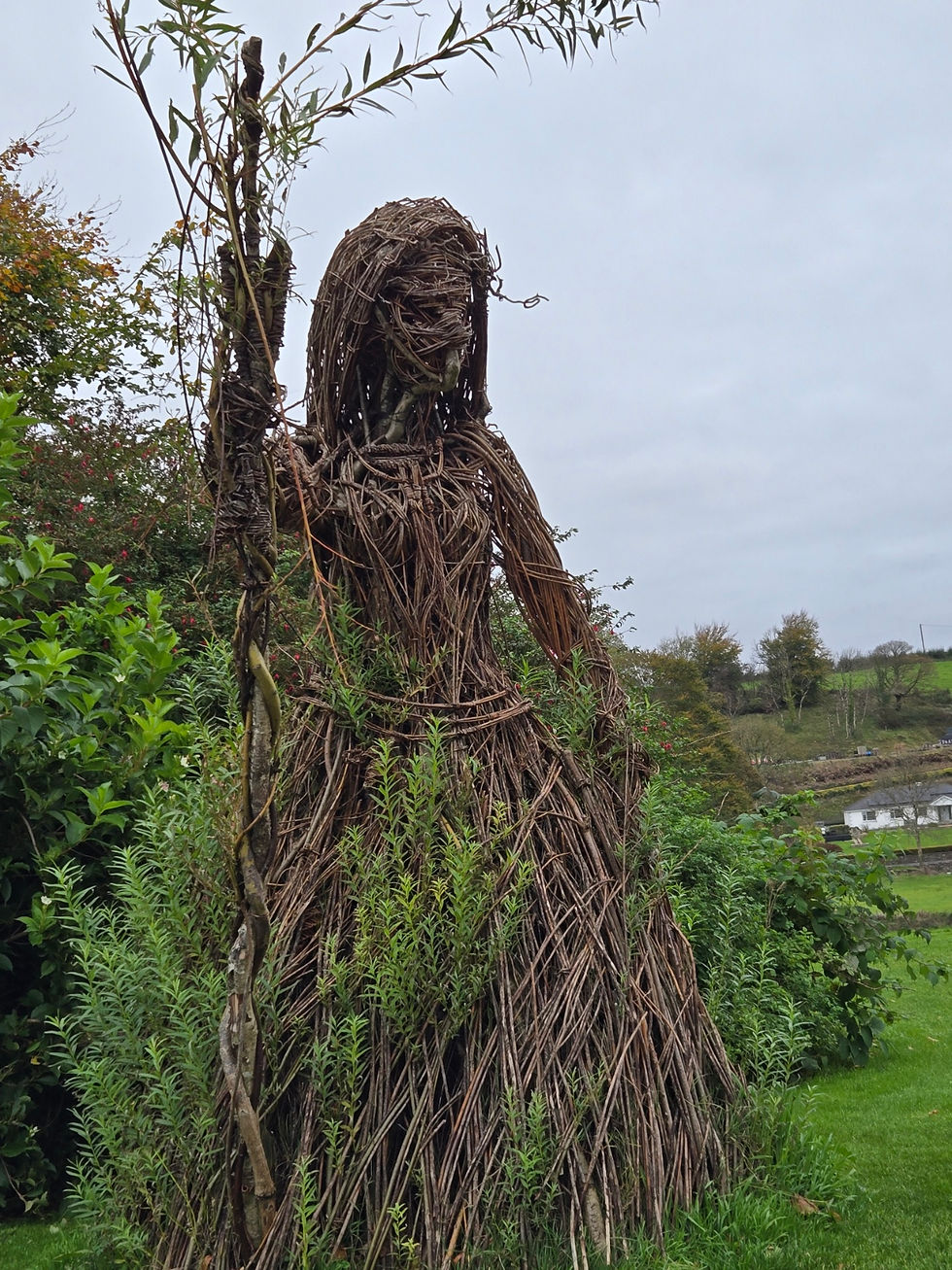
The memorial features a striking and somber statue of a coffin ship, one of the vessels that

carried so many immigrants to North America and Australia. The individuals boarding these ships were often weak and sick from months of inadequate food, and many perished during the treacherous voyages, earning these ships the grim nickname “coffin ships.” I interpret the statue as a representation of the souls of the deceased leaving the ship, though there are certainly other interpretations to consider.
Not to be flippant, this memorial would be a great place to hold a Halloween Party after all Halloween Irish roots.
After visiting another famine memorial, I was reminded of the profound impact the Great Famine had on County Mayo and County Galway, which is why there are numerous memorials in this area. We arrived in Clifden, where we’ll be staying for two nights and can finally do some laundry. I’m looking forward to the much-needed break and rest. I had forgotten how demanding these trips can be. I don’t think I'll opt for a move-every-day itinerary again; it’s just too exhausting.
Clifden Weather: Cloudy with scattered showers
High 59 F (15 C) Low 42 F (6 C)
Sunrise: 7:46 Sunset 18:42 (6:42 IDT)
Hours of Daylight: 10 hours and 56 minutes


Comments